


Vibrating foam roller vs a regular foam roller: which should you buy?
If you're shopping for a vibrating foam roller in Australia, the first question is whether the motor is worth paying for over a plain foam roller. Both put your body weight onto a muscle and let you roll it. The difference is what happens where the roller meets you, and how much work you have to do to get the feel you're after.
Quick answer: A regular foam roller is cheap, silent and never needs charging, and it suits people who already roll often and like firm pressure. A vibrating roller adds a motor that makes the surface vibrate thousands of times a minute, which many people find makes rolling feel more comfortable and easier to stick with. It's the better pick if you want shorter, more targeted sessions or a roller you can take anywhere.
What a regular foam roller does
A standard foam roller is a cylinder of dense foam, usually somewhere between 30 and 90 cm long. You lie on it and use your arms and legs to move your body back and forth. All the pressure comes from your body weight and how you position yourself.
It's simple, and for plenty of people it's all they need. The trade-offs show up in use. Long rollers are bulky. The pressure is spread across a wide area. Getting onto the right spot on your back or hips takes some shuffling. And firm foam can feel intense on tender areas, which is why a lot of foam rollers end up living behind the door.
What a vibrating roller adds
A vibrating roller has a rechargeable motor inside that makes the surface oscillate. Speed is usually quoted in RPM, and most models give you a few fixed levels plus an automatic mode that cycles between them.
What changes is the feel. Instead of static pressure, the muscle gets pressure plus rapid vibration. Many people describe it as less sharp than rolling on plain foam, and find they can relax into it rather than bracing against it. That tends to mean you slow down, hold a spot for longer and get more out of a ten-minute session.
The other practical difference is size. Because the vibration does part of the work, vibrating rollers are often shorter and more shaped than a long foam log, which makes them much easier to pack.
Vibrating vs regular foam roller at a glance
| Regular foam roller | Vibrating roller | |
|---|---|---|
| Where the pressure comes from | Your body weight only | Your body weight plus motor vibration |
| Settings | None; firmness is fixed | Several speed levels, often an auto mode |
| Typical size | Long; often 30–90 cm | Usually compact and shaped |
| Power | None needed | Rechargeable battery, ideally USB-C |
| Noise | Silent | A motor hum that rises with speed |
| Portability | Awkward in a gym bag | Fits a gym bag or carry-on |
| Session timing | Up to you | Many have an auto shut-off timer |
| Price | Lower | Higher |
Buying a vibrating foam roller in Australia: what to check
Not all vibrating rollers are built the same. These are the details worth checking before you buy:
- Speed range and levels. A spread of settings lets you start gentle and step up. Look for actual RPM figures rather than vague claims about power.
- Battery life and charging. Look for a runtime stated in minutes per charge, and USB-C so you can use the same cable as your phone.
- Auto shut-off. A timer, commonly 15 minutes, keeps sessions from running long and saves battery.
- Shape. Straight barrels cover big areas like thighs. Dual-lobe (peanut) shapes let you work either side of the spine.
- Weight and size. If it's going in a gym bag or on a plane, something under a kilo makes a real difference.
- Surface material. Silicone wipes clean easily and grips well, which matters if you use it on bare skin.
- Warranty and returns. Check the warranty length and whether there's a money-back period. Buying from a seller that ships from within Australia keeps any warranty claim simple.
Who should stick with a regular foam roller
If you already roll most days, like firm pressure and mainly work big areas like quads and upper back at the gym, a plain foam roller does the job for very little money. It never needs charging and it's silent, which matters if you roll in a shared space or late at night.
Who is better off with a vibrating roller
- You find plain rolling too intense and tend to give up on it.
- You want to work specific spots, like the muscles either side of your spine, rather than whole areas.
- You travel or train in different places and want something that fits in a bag.
- You like a short, structured session with a timer that decides when you're done.
The two RECOVERO rollers
We make two vibrating rollers and they suit different jobs. Neither is actually foam: both use high-grade silicone, which is easier to keep clean.
RECOVERO ROLL: compact and spine-friendly
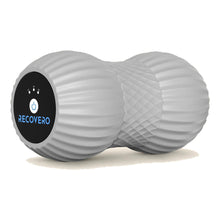
RECOVERO ROLL is a peanut-shaped, dual-lobe roller with a centre channel, so pressure sits on the muscles either side of the spine rather than on it. It has three vibration levels (3,200, 3,700 and 4,300 RPM) plus an Auto mode that cycles through the range. It runs for up to 120 minutes per charge, charges by USB-C, switches itself off after 15 minutes and weighs 740 g at 16 cm long.
RECOVERO ROLL 2.0: vibration plus warmth
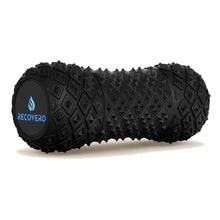
RECOVERO ROLL 2.0 is a straight, textured barrel that adds warmth to the vibration. It warms to about 45°C in around a minute and has three vibration levels (3,500, 4,000 and 4,500 RPM) plus auto. Warmth and vibration have separate buttons, so you can use either one on its own. It's 210 mm long, weighs 0.86 kg and runs for up to 150 minutes per charge.
Not sure which shape suits you? Our guide on how to use a vibrating peanut roller walks through back, neck and calf technique step by step.
The bottom line
A regular foam roller is a fine, low-cost tool if you'll use it. If you've bought one before and it gathers dust, a vibrating roller is worth a look. For a compact roller that works either side of the spine, start with RECOVERO ROLL. If you'd rather have warmth and a longer barrel, look at RECOVERO ROLL 2.0. Both ship from Australia with a 30-day money back guarantee and a 12-month warranty.
Frequently asked questions
Is a vibrating foam roller worth it over a regular one?
It depends on how you'll use it. If plain rolling feels too intense, or you want something portable with a set session length, many people find the vibration makes it easier to keep up. If you roll daily and like firm pressure, a regular roller is fine.
How long should a vibrating roller session be?
Most people use one for about 5 to 15 minutes, spending a minute or two on each area. Both RECOVERO rollers switch off automatically after 15 minutes.
Can I roll over my spine?
Avoid rolling directly over bones and joints. A dual-lobe roller like RECOVERO ROLL is shaped so your spine sits in the centre channel and the pressure goes to the muscles either side.
Are vibrating rollers loud?
They hum, and the sound rises as you go up through the speed levels. A plain foam roller is silent, so if noise matters to you, that's one point in its favour.
Is a vibrating roller suitable for everyone?
No tool suits everyone. If you're pregnant, recovering from injury or surgery, or managing a medical condition, speak to your doctor or physiotherapist before using one.