


How to use a vibrating peanut roller on your back, neck and calves
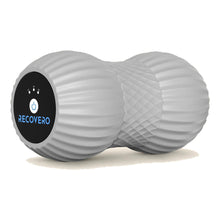
A vibrating peanut roller is a two-lobed roller with a groove down the middle and a motor inside. The shape is the whole point: it lets you roll the long muscles either side of your spine without pressing on the spine itself, and it's small enough to work into the neck and calves. Here's how to use one properly, area by area.
Quick answer: Position the roller so your spine sits in the centre channel, start on the lowest vibration setting and move slowly, spending a minute or two on each area. Control the pressure with how much body weight you put on it, keep off bones and joints, and keep the whole session to around 10 to 15 minutes.
How a vibrating peanut roller works
A regular round roller presses straight across whatever is underneath it. A peanut roller has two raised lobes with a channel between them. Lie back on it with the roller across your back and the lobes sit on the muscles either side of your spine while the spine itself sits in the gap.
The vibration adds rapid movement to that pressure. On RECOVERO ROLL you get three levels (M1 at 3,200 RPM, M2 at 3,700 RPM and M3 at 4,300 RPM) plus an Auto mode that cycles between 3,200 and 4,300 RPM. It's 16 cm long and 9 cm across, which is compact enough to use on the floor, against a wall or on a chair.
Ground rules before you start
- Start low. Begin on the lowest setting and step up only if you want more.
- Go slowly. Move a couple of centimetres per second, or simply hold still on one spot.
- Use your limbs to control pressure. Hands and feet on the floor take weight off the roller; lifting them puts more on.
- Keep off bones and joints. Stay on muscle, and never press into the front or sides of the neck.
- Breathe normally. If you catch yourself holding your breath or tensing up, ease off.
- Firm is fine, sharp is not. If something feels sharp, back off or move on.
Using a vibrating peanut roller on your upper and mid back
This is where the peanut shape does its best work.
- Sit on the floor with your knees bent and the roller on the floor behind you, lying across your body.
- Lean back so the roller sits just below your shoulder blades, with your spine in the centre channel and one lobe either side.
- Cross your arms over your chest, or support your head with your hands.
- Lift your hips slightly and push gently through your feet to roll up towards the top of your shoulder blades, then back down.
- When you find a spot that feels tight, stop and hold for 20 to 30 seconds and let the vibration do the work.
For the lower back, go gentler. Many people prefer to keep their hips on the floor and let the roller sit still under the lower back, rather than rolling across it with full body weight.
Using it on your neck
The neck needs the lightest touch of all. The weight of your head is plenty.
- Lie on your back with your knees bent.
- Place the roller under the base of your skull, with your neck in the centre channel.
- Switch to the lowest setting.
- Let your head rest, then slowly turn it a little to one side and back, or make small nodding movements.
- Keep it to a minute or two.
Stay on the back of the neck only. Don't press the roller into the front or sides of your throat.
Using it on your calves
- Sit with your legs out in front of you and the roller under one calf.
- Place your hands on the floor behind you and lift your hips so your weight moves onto the roller.
- Roll slowly from just below the back of the knee to just above the ankle. Avoid rolling directly behind the knee.
- Turn your foot in and out to reach the inside and outside of the calf.
- For more pressure, cross the other leg over the top.
You can also turn the roller so that one lobe presses into one side of the calf at a time, which many people find more focused.
Other places people use it
- Glutes: sit on the roller and lean slightly to one side.
- Hamstrings: sit on a chair or the floor with the roller under the back of your thigh.
- Feet: sit in a chair and roll it slowly under a bare foot with light pressure.
- Against a wall: stand with the roller between your upper back and the wall and bend your knees to move it up and down. This is handy if getting down to the floor isn't practical.
A simple 10-minute routine
- Upper and mid back, 3 minutes: start on M1, move to M2 if it feels good.
- Neck, 1 to 2 minutes: M1 only.
- Calves, 2 minutes each side: M1 or M2.
- Glutes, 1 to 2 minutes: whatever setting feels right.
If you'd rather not think about settings, use Auto mode and let the roller cycle through its range. RECOVERO ROLL switches itself off after 15 minutes, so it's hard to overdo a session.
Common mistakes to avoid
- Rolling too fast, which turns it into a bumpy ride rather than a massage.
- Going straight to the highest setting.
- Rolling directly over the spine, bony points or joints.
- Staying on one spot for several minutes. A minute or two is plenty; move on and come back.
- Holding your breath and bracing against the pressure.
Still deciding whether you need a vibrating roller at all? Our comparison of a vibrating foam roller vs a regular foam roller covers the trade-offs.
Ready to roll?
RECOVERO ROLL is our dual-lobe vibrating roller, built for exactly the techniques above. It weighs 740 g, runs for up to 120 minutes per charge, charges by USB-C and comes with a carry pouch for the gym bag. It ships from Australia with a 30-day money back guarantee and a 12-month warranty.
Frequently asked questions
What is the groove in the middle of a peanut roller for?
The centre channel gives your spine somewhere to sit, so the two lobes press on the muscles either side instead of on the spine itself.
How long should I spend on each area?
About a minute or two per area is common, with a total session of 10 to 15 minutes. RECOVERO ROLL turns off automatically after 15 minutes.
Which vibration setting should I use?
Start on the lowest setting, especially on the neck. Many people move up a level on the back and calves once they're used to the feel.
Can I use it every day?
Many people use a vibrating roller daily as part of a short routine. Keep sessions sensible and skip any area that feels sharp or uncomfortable.
Is it suitable for everyone?
If you're pregnant, recovering from injury or surgery, or managing a medical condition, speak to your doctor or physiotherapist before using it.