


How to use a trigger point massage ball on glutes, shoulders and feet
A trigger point massage ball is the simplest tool in the kit: a small, firm ball you lean or sit on so your body weight presses into one spot. Add a motor and you get a vibrating massage ball, which puts focused pressure and vibration exactly where a roller can't quite reach. Here's how to use one on the three places people reach for it most: glutes, shoulders and feet.
Quick answer: Place the ball under or behind the spot you want to work, then use your body weight to control the pressure, starting on the lowest setting. Move slowly or hold still for 20 to 60 seconds per spot, keep off bones, joints and the spine, and keep the whole session to around 10 to 15 minutes.
What a trigger point massage ball does differently
A roller spreads pressure across a wide strip of muscle. A ball concentrates it on a single point. That makes it better for small or awkward areas: deep in the glutes, around the shoulder blades and under the arch of the foot.
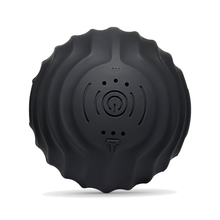
A vibrating massage ball adds rapid movement to that pressure. RECOVERO TRIGGER POINT ROLL has four modes: low (1,500 RPM), medium (3,000 RPM), high (3,800 RPM) and pulsating. Many people find the vibration makes firm, focused pressure feel more manageable, so they can stay on a spot rather than jumping off it.
Ground rules for using a vibrating massage ball
- Start on low. Focused pressure plus vibration can feel strong at first.
- Let your body weight do the work. More weight means more pressure. Take weight off with your hands or legs to ease it.
- Move slowly, or hold. Small, slow movements or a still hold of 20 to 60 seconds work better than rolling fast.
- Stay on muscle. Keep off the spine, bony points and joints.
- Firm is fine, sharp is not. If it feels sharp, shift a few centimetres or back off.
- Keep it short. A couple of minutes per area is plenty.
How to use a trigger point massage ball on your glutes
The glutes are big, deep muscles, and sitting on a ball is one of the easiest ways to get into them.
On the floor
- Sit on the floor with the ball under one side of your backside and your hands behind you for support.
- Cross the ankle of that side over the opposite knee if you want more pressure, or keep both feet on the floor for less.
- Lean slightly towards the ball and make small circles, or find a spot that feels tight and hold still.
- Spend one to two minutes, then swap sides.
On a chair
If the floor isn't practical, sit on a firm chair with the ball under one side. You get less pressure than on the floor, which suits a gentler session or a break at the desk.
Using it on your shoulders and upper back
For the shoulders, a wall is your best friend. It lets you control pressure precisely without lying down.
- Stand with your back to a wall and place the ball between the wall and the muscle beside your shoulder blade. Keep it off the spine.
- Walk your feet a little forward and lean back into the ball.
- Bend and straighten your knees slowly to move the ball up and down, or step side to side to shift it across.
- When you land on a tight spot, hold for 20 to 60 seconds. Many people like to slowly cross the arm on that side over their chest while holding.
- Swap sides after a minute or two.
For more pressure, do the same thing lying on the floor. Keep the ball on the muscle around the shoulder blade, not on the shoulder joint itself or the top of the collarbone.
Using it on your feet
The arch of the foot is one of the places a ball fits better than anything else.
- Sit in a chair with a bare foot resting on the ball, on the lowest setting.
- Roll the ball slowly from the ball of the foot through the arch, and back.
- Once that feels comfortable, stand and hold onto something for balance, then put a little more weight through the foot.
- Spend a minute or two per foot.
Keep off the heel bone and the ankle bones, and go gently. Feet are sensitive and a little pressure goes a long way.
Other spots people use it on
- Calves: sit with the ball under one calf and lift your hips to add weight.
- Forearms: rest your forearm on the ball on a table and press down with the other hand.
- Chest: stand facing a wall with the ball between the wall and the muscle just below the collarbone, away from the armpit.
Ball or roller: when to use which
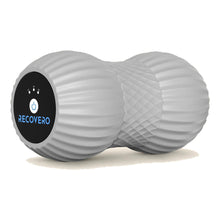
A ball is for precision; a roller is for coverage. If you want to work long muscles like the back, hamstrings and calves in one pass, a roller is quicker. If you want to find and stay on one spot, the ball wins. Plenty of people use both: the roller first to cover the area, then the ball for the spot that needs more attention. Our guide on how to use a vibrating peanut roller covers the roller side, and RECOVERO ROLL is our dual-lobe option.
Choosing a vibrating massage ball
- Size: too small and it digs in; too large and it loses focus. RECOVERO TRIGGER POINT ROLL is 9.5 cm across.
- Surface: anti-slip silicone stays put against a wall or floor.
- Modes: a clear spread of speeds, and ideally a pulsating option for variety.
- Auto shut-off: a timer stops you overdoing one spot.
- Weight: light enough to live in a gym bag or desk drawer.
Try it for yourself
RECOVERO TRIGGER POINT ROLL is our vibrating massage ball: 9.5 cm across, 430 g, four modes, a built-in 1,200 mAh battery and a 15-minute auto shut-off. It has no heat function, charges via the included USB-A to Type-C cable and fits in a gym bag, desk drawer or carry-on. It ships from Australia with a 30-day money back guarantee and a 12-month warranty.
Frequently asked questions
How long should I hold a trigger point massage ball on one spot?
Around 20 to 60 seconds per spot is common, with a minute or two per area overall. Move on if it feels sharp.
Which mode should I start on?
Start on low (1,500 RPM on RECOVERO TRIGGER POINT ROLL) and move up once you're used to the feel. Many people keep the feet on low.
Can I use a massage ball on my neck or spine?
Keep it off the spine and the front and sides of the neck. For the muscles either side of the spine, a dual-lobe roller is a better fit.
Is a vibrating massage ball better than a plain one?
A plain ball does the same basic job. Many people find the vibration makes firm, focused pressure easier to stay with, and the modes give you more control.
Who should check with a doctor first?
If you're pregnant, recovering from injury or surgery, or managing a medical condition, speak to your doctor or physiotherapist before use.